
wellortho@welltrusttech.com
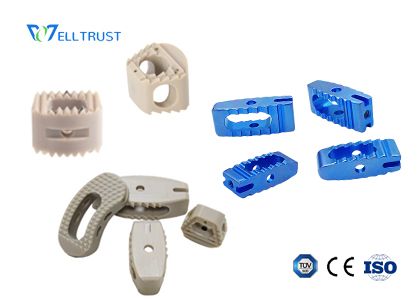
A PEEK interbody cage for lumbar fusion should be evaluated as part of a complete spinal implant configuration. Hospitals, medical device distributors and professional buyers should review the intended spinal region, surgical approach, cage dimensions, profile, graft window, instrument compatibility and available product documentation before making a purchasing decision. The correct selection depends on the clinical plan and the technical requirements of the intended system.
This guide explains the main factors to review when evaluating a PEEK cage for lumbar fusion. It is written for product education and procurement reference. It does not replace professional training, clinical judgment, surgical planning or the manufacturer’s instructions for use.
PEEK is an abbreviation for polyetheretherketone, a polymer used in a range of medical implant applications. A PEEK interbody cage is designed to occupy the intervertebral disc space as part of a selected spinal fusion procedure. The cage is evaluated together with the surrounding fixation strategy, graft approach and compatible instruments.
The term PEEK spinal cage can refer to different configurations for different spinal regions and surgical approaches. A cage intended for the cervical spine should not automatically be evaluated using the same criteria as a lumbar interbody cage. The intended anatomy, approach and product documentation should be confirmed before the model is selected.
“PEEK cage” is a broad product term. A purchasing team looking for a cage for lumbar fusion may need information about the approach, available height range, footprint, profile, graft window and related instruments. These requirements are more specific than a general search for PEEK spinal implants.
For this reason, a supplier inquiry should identify the intended lumbar application and the required configuration as clearly as possible. If the exact model is not yet known, the buyer can provide the intended procedure category, target market, required documentation and any available technical references for review.
The first step is to confirm the intended spinal region and approach. Cervical, lumbar and other spinal configurations may have different design requirements and compatible instrument sets. A lumbar cage should therefore be evaluated within the context of the intended lumbar fusion procedure rather than as a generic implant.
Distributors and hospital purchasing teams should also confirm whether the requested product is a cage, an instrument set or a complete system component. This distinction helps prevent a product page, quotation or internal catalog from grouping unrelated items under the same keyword.
Cage height and footprint are central product-selection fields. The available dimensions should be reviewed against the intended product configuration and the technical documentation supplied by the manufacturer. Buyers should request the complete size table rather than relying on a general product name.
The footprint should also be considered together with the cage profile and the intended spinal region. A product comparison is more useful when it presents height, width, length and profile as a related group instead of showing isolated measurements without context.
Profile and angle are important when comparing different interbody cage configurations. The purchasing team should confirm which profiles are available, how they are identified and whether the product documentation explains their intended configuration.
The graft window is another important field for product comparison. Buyers should verify the opening design, available dimensions and the manufacturer’s terminology. If the page does not provide these details, the inquiry should request them directly before the product is added to a hospital or distributor catalog.
Material information can affect how a product is evaluated during product review and imaging-related discussions. WELLTRUST product information includes PEEK and titanium cage categories within the spinal product range. The exact material, design and available configuration should be confirmed for the specific model under consideration.
Marketing copy should avoid making broad clinical or imaging claims unless those statements are supported by the applicable technical documentation. A precise product page should state the confirmed material and design attributes, then direct professional users to the relevant instructions and technical documents.
A PEEK interbody cage should not be evaluated separately from its compatible instruments. Before placing an order, the buyer should confirm the related instrument set, the intended approach, the product interface and the documentation needed to review compatibility.
WELLTRUST’s spinal product range includes PEEK and titanium cage categories together with related instrument-set pages for PLIF, TLIF and cervical configurations. The appropriate combination should be confirmed according to the selected cage, intended approach and current technical documentation.
PEEK and titanium cage options should be compared using a defined set of product and procurement criteria rather than a single “better” or “worse” claim. A professional comparison can include:
| Comparison field | Questions for product evaluation |
|---|---|
| Material | What material is used for the selected model, and which technical documents confirm it? |
| Spinal region | Is the configuration intended for the required cervical or lumbar application? |
| Dimensions | Which height, footprint, angle and profile options are available? |
| Graft window | What graft-window design and dimensions are specified for the model? |
| Instruments | Which instrument set is compatible with the cage and the intended approach? |
| Documentation | Which specifications, instructions, packaging information and market documents can be supplied? |
| Supply | What are the minimum order quantity, lead time, quotation requirements and OEM conditions? |
This framework allows hospitals and distributors to compare the actual product configuration without turning a technical comparison into an unsupported clinical claim. Final selection should follow the responsible healthcare professional’s judgment and the applicable product documentation.
Before requesting a quotation or adding a PEEK interbody cage to a product portfolio, procurement teams should confirm the following information:
A complete procurement checklist helps the supplier respond with the right product information and reduces the risk of selecting a cage based only on a broad keyword or a product photograph.
WELLTRUST provides spinal implant and instrument resources for professional product evaluation. Buyers can review the following related pages:
For a broader explanation of PEEK cage terminology and selection factors, readers can also review PEEK Spinal Cages Explained: Types, Applications, and Selection Factors. This article focuses more specifically on the lumbar-fusion procurement and evaluation context.
A PEEK interbody cage is a spacer made from polyetheretherketone and designed for use in selected spinal fusion procedures. The exact model, indication and compatible instruments should be confirmed through the manufacturer’s documentation and the responsible healthcare professional.
Key factors include the intended spinal region and approach, cage height, footprint, profile, angle, graft window, material, instrument compatibility and available product documentation.
Compare the material, spinal configuration, dimensions, profile, graft-window design, instrument compatibility, documentation and supply requirements. Avoid making a clinical superiority claim unless it is supported by appropriate evidence and product documentation.
WELLTRUST provides related spinal instrument-set pages for PLIF, TLIF and cervical PEEK cage configurations. The exact instrument set should be confirmed according to the selected cage and intended approach.
A distributor should request the relevant product specifications, model information, compatibility details, instructions, packaging information and available market-specific quality or regulatory documents. The exact document set depends on the target market and product configuration.
Choosing a PEEK cage for lumbar fusion requires more than checking the material name. Hospitals and distributors should evaluate the intended spinal region, approach, cage dimensions, profile, angle, graft window, instrument compatibility and available documentation as one product configuration.
WELLTRUST provides PEEK and titanium cage categories together with related spinal instrument resources. By confirming the selected model, compatible instruments, technical documents and commercial requirements before ordering, professional buyers can make a clearer decision about the appropriate PEEK interbody cage for their procurement needs.
Tel: 86-18102187175
Whatsapp:86-18102187175
E-mail: wellortho@welltrusttech.com
Working Hours: Monday-Friday UTC+8: 9:00AM-6:00PM
Add1: 1-1301 Xindu Building, Wandezhuang Street, Wanxing Street, Nankai District, Tianjin, China
Registered address: Room 225, No.2 Huatian Rd., Huayuan Industrial Park, Binhai High-tech Zone, Tianjin, China.
Well Trust(Tianjin) Tech. Co.,Ltd


